
White-label podcast reporting, and what it actually requires.
Outsourced reporting succeeds when the client never has a reason to wonder about it. That is a higher bar than putting a logo on a template, and it is mostly an operations problem rather than a design one.
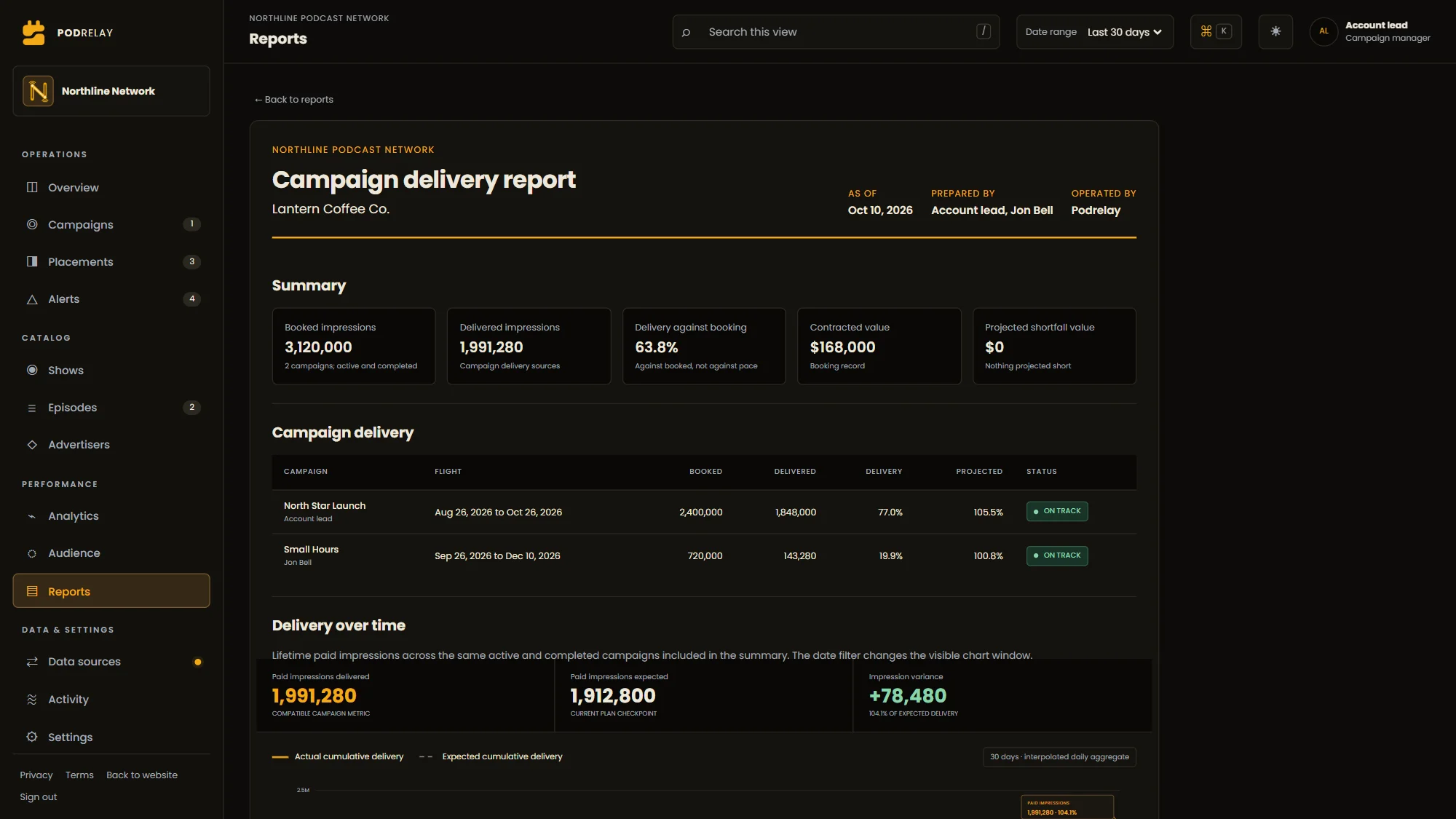
What the client should experience
The test is simple. Across a full quarter, nothing about the report should suggest a third party exists: not the branding, not the file naming, not the tone of the commentary, not the turnaround, and not the answer when an account manager is asked where a number came from.
Most white-label arrangements pass the first three and fail the last two. Branding is easy. Predictable delivery and instant traceability are the difficult parts, and they are the parts clients actually notice.
Branding is the least of it
Logo, color, typography and template are table stakes. The parts that give an arrangement away are subtler: a commentary voice that does not match how your account team writes, inconsistent metric naming between one month and the next, or a file naming convention that changes when a different person produces the report.
Agree the vocabulary as carefully as the visual identity. If your team says "delivered impressions" and the report says "served impressions", somebody will eventually ask why, and the answer will be about your supplier rather than about the campaign.
Predictability beats speed
Agencies often negotiate hard on turnaround, then discover the number they needed was "certain" rather than "fast". An account manager can plan around a report that always arrives on the third working day. They cannot plan around one that usually arrives in two days but occasionally takes six, because they have already promised the client.
Define the cycle, define what happens when a source platform is late, and define who tells the account team. Design against silence, not slowness.
Who owns quality
This is the question that separates a genuine reporting operation from a production service, and it should be settled before any work starts. A production service formats the data it is given. A reporting operation reconciles the data first and takes responsibility for what it hands over.
Concretely, a provider should be able to say which checks run before delivery, what happens when two sources disagree, who decides the treatment of an exception and where that decision is recorded. If the answer is that discrepancies are passed back for the agency to resolve, that is a legitimate model, but it is not a reduction in your workload and should not be priced as one.
Delivery accuracy sits underneath all of it. A report can be beautifully reconciled and still be wrong if a placement never ran, which is why reporting and ad verification belong in the same operation rather than in separate contracts.
Data access, without a migration
A reasonable arrangement works with the stack you already have. Hosting, distribution, ad-serving, attribution, sales and analytics tools stay where they are as the systems of record. With your permission, the reporting layer connects directly to their platform-native data or uses approved exports, then preserves the source and definition behind every figure.
What does need agreeing is access: which systems, at what permission level, through which accounts, and what happens to that access when the engagement ends. Read-only service accounts owned by the agency are the sane default, because they survive personnel changes on both sides.
Confidentiality has two directions
The obvious direction is your client data, which should be covered by an agreement that names retention, storage location, sub-processors and deletion on termination.
The direction agencies forget is commercial. Your rate card, your margin structure, your show-level performance and your advertiser roster are all visible to whoever produces the reporting. That is normal and unavoidable, but it should be explicitly covered rather than assumed, particularly where a provider also works with other agencies in the same market.
What you should be able to ask for at any moment
- The source and definition behind any figure in the last twelve months
- The current status of every campaign in the reporting cycle
- A list of open exceptions and who owns each one
- The template and asset files, in an editable format you can take elsewhere
- A record of what changed between two versions of a report
If any of those requires a request and a waiting period, the arrangement has a dependency problem. The point of outsourcing production is to remove work, not to remove access.
The exit test
Before signing, ask what leaving looks like. Who owns the templates, the definitions document, the historical outputs and the automation logic. A provider confident in the value of the ongoing operation will answer that comfortably. A provider whose value rests on you being unable to leave will be vague, and that vagueness is the most reliable signal available to you.
Why agencies do this at all
The honest reason is rarely cost alone. It is that reporting is a recurring, deadline-bound obligation that consumes senior account time at exactly the moment that time is most valuable, and it scales linearly with the client roster while adding nothing to the pitch. Handing the repeatable part to a dedicated operation buys back the hours, but only if what comes back needs no rework.
That is the whole standard. Not cheaper reports. Reports the account team can send without reading twice. If you want to see how that operation is structured, the reporting operations service describes what gets built and what gets managed each month.
Contents
Common questions
What does white-label podcast reporting mean?
It means an external operator builds and runs the reporting work while every client-facing artifact carries the agency's brand, templates and voice. The client relationship, the account conversation and the final approval stay with the agency.
Does white-label reporting require changing our tools?
It should not. Your hosting, distribution, ad-serving, attribution, sales and analytics platforms remain the systems of record. With your permission, the reporting operation connects directly to those sources or uses approved exports, then normalizes their data without forcing a migration.
Who is accountable when a report is wrong?
The agency is accountable to its client, which is exactly why the arrangement has to define who checks what before delivery. A credible provider owns reconciliation and QA, surfaces exceptions before the client sees them and can show the record behind any figure on request.
How fast should a white-label reporting cycle be?
Turnaround matters less than predictability. An agreed, repeatable cycle the account team can plan around is worth more than an occasionally fast one, because the account team's credibility depends on telling clients when something will arrive.