
Why direct-source podcast data still needs an operator.
Platform-native analytics describe what each system recorded. Attribution providers model response. Your CRM records the commercial plan. Production publishes what actually runs. Client-ready reporting begins when those sources are reconciled without pretending they measure the same thing.
Direct-source data is not the whole operation
Hosting platforms, YouTube, Spotify, Apple Podcasts, ad servers and commercial systems are the direct sources for the information they record. Podscribe, Magellan and similar providers remain valuable independent sources for attribution, verification and market intelligence. Podrelay does not replace any of them. With the client's permission, it brings their approved outputs into one reporting operation.
That distinction matters. Podrelay does not independently observe listeners or originate attribution. It connects to the data the client already controls or is authorized to use, preserves the source and definition behind each figure, and reconciles it with the commercial and published record.
The three versions of truth
Source data and measurement
Platform-native analytics describe downloads, views, streams and delivery under each platform's own rules. Attribution providers can add modeled or matched response and outcome data. Both are useful, but they answer different questions and should remain labeled as such.
Commercial plan
A CRM such as Boostr, an insertion order or another booking system describes what was sold. It records the advertiser, show, flight, placement, expected date and contracted quantity.
Published reality
Production determines what actually airs. Episodes can publish late, placements can move and additional content can appear outside the original schedule.
Where live discrepancies come from
- An episode publishes later than the booked schedule expected
- A sponsor read moves from one episode or slot to another
- Underdelivery creates a make-good that must be tracked into a later cycle
- A bonus video or social asset runs even though it was not part of the original contract
- Show, episode or advertiser naming differs across systems
- A production change is communicated in one team but never reaches the reporting record
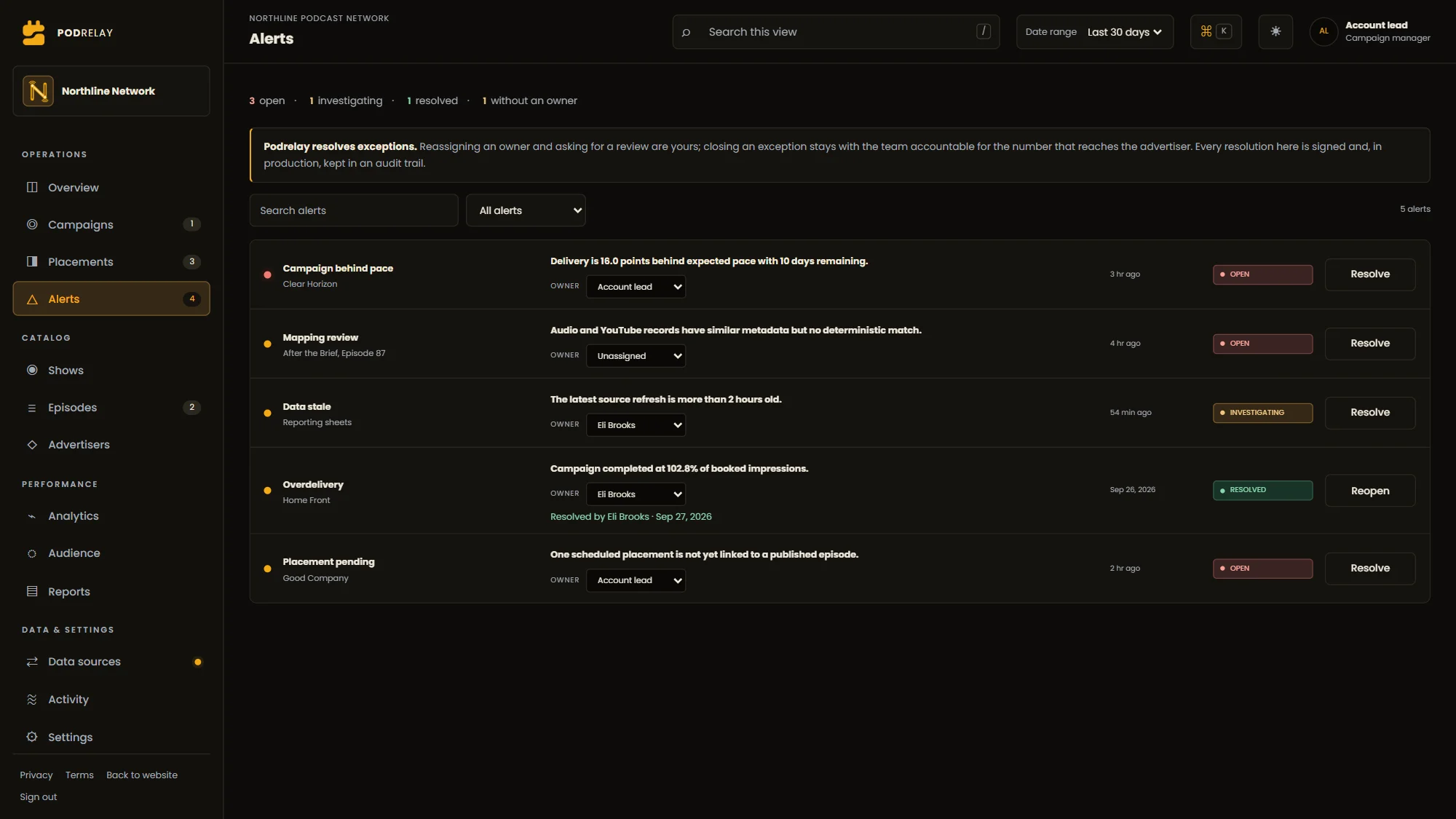
Most of these are operational exceptions rather than data failures. They need context, ownership and a documented decision about what should be reported.
Why software alone is not enough
Automation is excellent at collecting data, matching known fields, applying validation rules and surfacing exceptions. It is less reliable when the correct answer depends on a production conversation, a commercial agreement or a last-minute client decision.
That is where human oversight matters. We monitor unresolved discrepancies, confirm the agreed treatment, log the exception and keep the reporting record current. Automation handles the volume. We remain accountable for the ambiguity.
The managed direct-source reporting layer
Podrelay sits above the existing stack as a managed reporting and quality-control operation. Hosting and distribution platforms remain authoritative for their native analytics. Attribution providers remain authoritative for the measurement they produce. The CRM remains the commercial source. Production tools remain where content is managed.
The layer we provide aligns those client-authorized inputs into one client-ready operating truth: sources reconciled, definitions preserved, exceptions documented, reports verified and every unresolved issue given an owner. No Podrelay listener-tracking pixel or podcast prefix is required.
What clients ultimately receive
Clients do not need to understand why three internal systems disagreed. They need a report that is accurate, legible and supported by a clear record. The value is not another dashboard. It is confidence that somebody is monitoring the entire reporting cycle and making sure nothing gets lost between teams or tools.
Contents