
Give account leads time back
Move recurring collection and report preparation into a maintained workflow so your team can focus on clients, campaign plans and renewals.
Give account leads more time for planning, client conversations and renewals. Podrelay builds and runs your podcast reporting automation: source collection, reconciliation, QA and white-label reports, plus a maintained dashboard if you want one, around the tools your agency already uses.
From a single anonymized engagement our founder led inside a major US media network, before Podrelay existed. Labor figure applies a conservative $35/hr blended internal rate. See the full case study →
Keep reporting dependable as client requests and campaign volume grow. Collection, reconciliation, dashboards and white-label delivery share one maintained workflow, with a human owner for the cases that need judgment.
Move recurring collection and report preparation into a maintained workflow so your team can focus on clients, campaign plans and renewals.
Reconcile figures, dates and source context before delivery. Your team gets a checked report and a clear record of exceptions that need attention.
Put campaign performance and delivery into clear branded reports, dashboards and QBRs that support useful client conversations.
The reporting operation runs the same way in both options. With Reporting, done for you, we automate the reporting around your existing tools, templates and process, verify the ads ran and deliver checked weekly or monthly reports. Your team keeps working in the systems it knows.
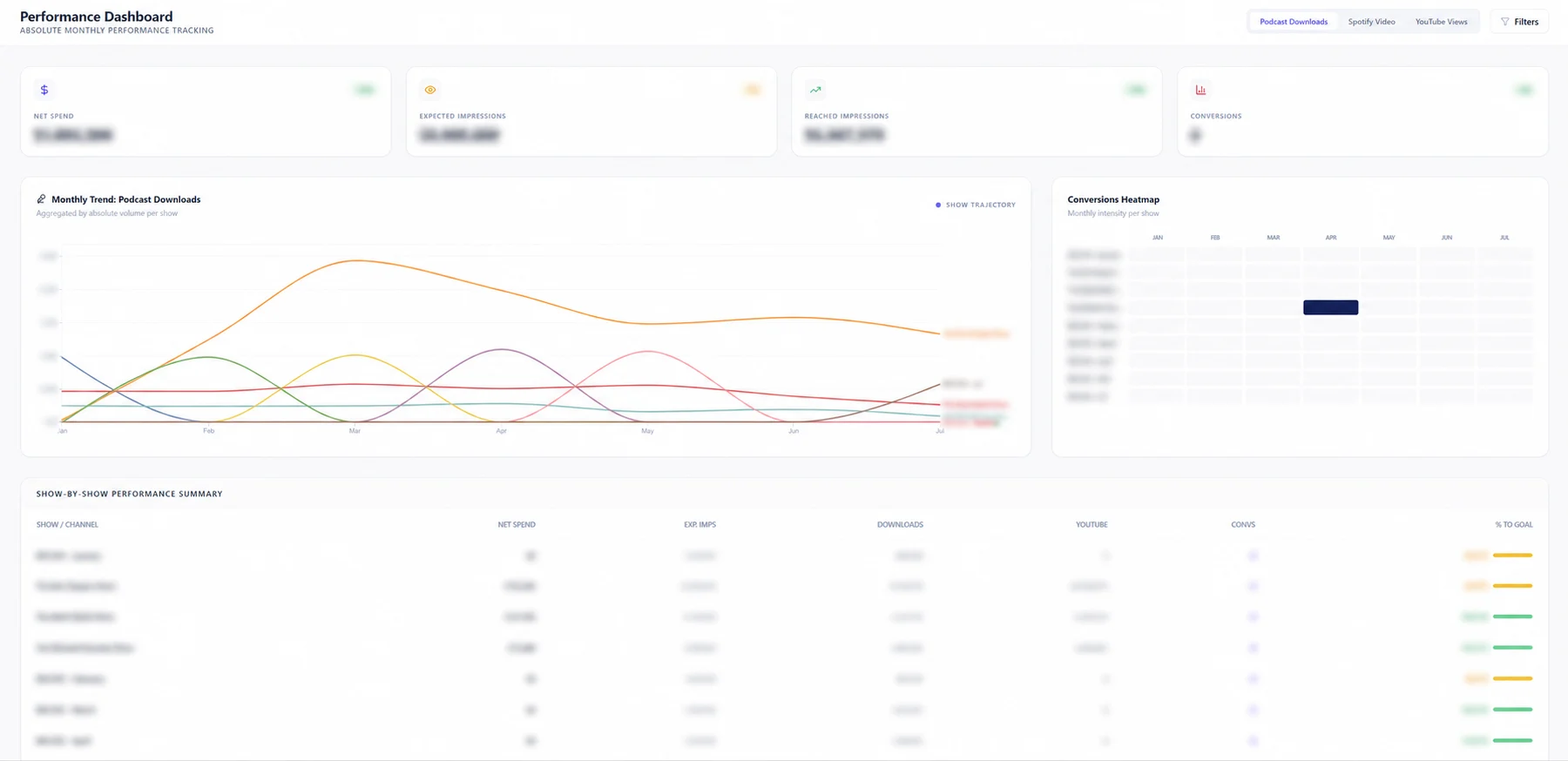
With Reporting + dashboard, you also get one branded dashboard for every show, platform and campaign: performance, audience, campaign pacing and verified ad delivery together. It draws on the same reconciled figures and agreed metric definitions as your reports, so the numbers stay consistent.
See what the dashboard includes or compare the two ways to work.
Your hosting, distribution, ad-serving, sales, attribution and analytics platforms remain the systems of record. With your permission, Podrelay connects directly to those systems or works from client-approved exports and shared workspaces. We pull only the fields the reporting operation needs, normalize the definitions and reconcile the result into a client-ready deliverable. No platform migration is required.
Track YouTube views and engaged views separately, alongside watch time and retention. We report each measure from your authorized YouTube analytics, preserving its definition and reporting period.
Podrelay is not an independent audience-measurement provider and does not need its own listener-tracking pixel or podcast prefix. If you use Podscribe or another attribution platform, its output remains one valuable source alongside platform-native analytics, booked campaign records and published delivery. We preserve where each number came from and what it actually represents.
The output can follow an existing template or become a completely new reporting experience. Either way, the agency brand and client relationship stay in front.
Podrelay connects the recurring work between your source platforms and client reporting. The workflow collects authorized inputs, maps show and campaign records, aligns reporting periods, checks totals and prepares the next deliverable. Approved exports can support sources where direct access is unavailable.
Before a reporting cycle is automated, we agree which system owns each metric, how often it can refresh and who handles missing or conflicting data. Reports and dashboards then share those definitions. A late export or revised figure becomes a visible exception with an owner.
See the source and capability reference or the podcast reporting automation workflow for an example of what needs to be defined.
Automation can move known inputs quickly. Live podcast advertising creates exceptions that still require judgment: late episodes, bonus inventory, underdelivery, changed schedules, uncontracted placements and conflicting records between production, sales and measurement systems.
We monitor those exceptions, reconcile the operating record and keep the final report honest. AI can help organize and explain verified information, but it does not get to invent the truth.
We start by mapping your workflow and building the reporting system. As shows, campaigns and client requirements change, we maintain your data connections, agreed metric definitions and report templates within the reporting scope. Your next account can use the reporting operation already in place, with its sources, templates and checks adapted to the agreed requirements.
A live view is only worth building when the data underneath it has already been reconciled. These are the three layers the client-facing dashboard is organized around.
Total delivery, pacing, remaining inventory and the campaigns that need attention before the reporting deadline.
Podcast downloads, YouTube views and engaged views, Spotify streams and conversions kept inside the correct platform context.
Spend, attributed revenue, efficiency and a concise decision brief without turning the dashboard into a spreadsheet.
Yes. Podrelay builds recurring collection and normalization around client-authorized source access or approved exports. The workflow maps shows, episodes, campaigns and reporting periods, reconciles the inputs and sends exceptions for human review before reports are delivered. Available fields and refresh schedules depend on the source.
Podrelay is a managed reporting operation. We build and maintain the collection, reconciliation, dashboards and recurring deliverables around your workflow. Your team works with an accountable operator rather than taking on another reporting platform to configure and run.
The reporting cadence is agreed for each workflow and depends on source availability. Scheduled reports preserve a defined reporting period; dashboards show the latest processed data. Source refresh times, reporting windows and late revisions should be visible alongside the figures.
It is a managed workflow that collects recurring reporting inputs, checks the numbers and produces client-ready outputs on a defined cadence. The goal is a dependable reporting operation, not merely faster exports.
No. The dashboard comes with Reporting + dashboard, on top of the full reporting operation, and is not sold on its own. The same verified data that produces your scheduled client reports feeds the always-current dashboard, which is what keeps the two consistent.
Not always. The dashboard provides an always-current operating view, while scheduled reports preserve a period-specific narrative, approval record or executive summary.
In this service, automated reporting is part of podcast automation. Both terms describe the same core outcome: less manual production and a more reliable reporting cycle. The reporting operation also includes QA, exception handling and client delivery.
AI can assist with organizing verified information, drafting summaries and surfacing patterns. Source reconciliation and ambiguous delivery cases remain subject to human review.
Yes. Reports, campaign wraps, dashboards and QBR decks can use your agency branding, existing templates or a new custom design.
From the systems your organization already controls or authorizes, including hosting and distribution platforms, ad servers, CRM or booking systems, attribution tools and internal reporting files. Depending on the source, Podrelay connects with permission or uses a client-approved export or shared workspace. We normalize and reconcile those inputs; we do not originate the underlying platform measurements.
No. The reporting operation does not require a Podrelay listener-tracking pixel or podcast prefix. If you already use Podscribe or another measurement provider, its approved output can remain one source in the reporting stack, with its attribution model and reporting context kept visible.
No. Podscribe is an independent measurement and attribution source. Podrelay is the reporting and operations layer that can combine its output with your platform-native analytics, ad-server delivery, commercial records and internal data. Your existing systems remain in place.
The architecture is agreed during implementation. Data may remain in client-controlled systems or be copied into a client-approved reporting workspace when normalization, quality control or dashboard delivery requires it. Before go-live, the parties document the approved locations, fields, access, retention and deletion process. The public portal contains fictional data only.
Podrelay minimizes the data used and requests only the access needed for the agreed workflow. The service is designed around aggregated platform metrics and operational records rather than identifying individual listeners. Where Podrelay processes personal data on a client's documented instructions, the parties define their roles and enter into a Data Processing Agreement when required. Security, confidentiality, subprocessors, international transfers, incident handling, retention and return or deletion are documented in the applicable agreement.
Bring one recurring report. We'll review where your team loses time, what needs checking and how the workflow could run around the tools you already use.
Book a reviewWe reply within one business day.