
Start from the booking
Take every contracted placement and confirm the right sponsor, creative, episode, slot and delivery window. Missing, late and misplaced reads surface as exceptions rather than surprises.
Two questions decide whether an advertiser trusts your reporting. Did the booked read actually run in the right episode and position? And what else went live that nobody logged? Podrelay answers both inside one verification record, from contracted proof of play to full-channel podcast and YouTube airchecks.
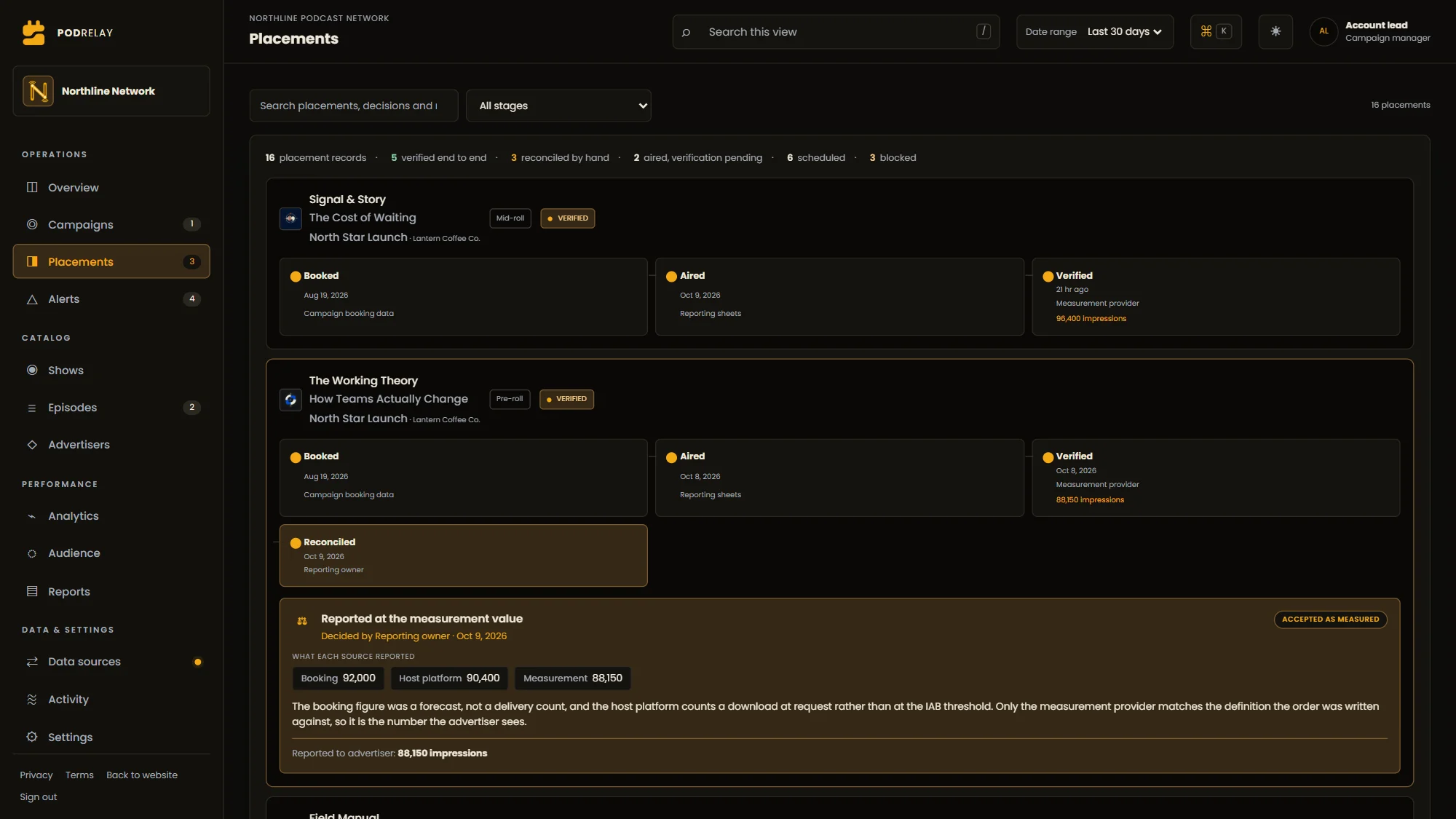
Checking only the booked schedule catches only what the schedule already knows about. Scanning only the published record misses the campaign obligations behind it. Running both directions against one another is what turns spot checks into a defensible delivery record.
Take every contracted placement and confirm the right sponsor, creative, episode, slot and delivery window. Missing, late and misplaced reads surface as exceptions rather than surprises.
Monitor podcast episodes and the full YouTube channel so sponsor placements are detected even when a release, bonus video or schedule change was never logged correctly.
Where the two records disagree, an operator investigates, updates the operational truth and makes sure the reporting team knows what actually happened.
Most agencies run these as separate habits. Someone spot-checks the campaigns an advertiser is likely to ask about, and separately someone notices that a bonus episode went out with a read in it. Neither habit produces evidence, and the two never reconcile.
Verification and show QC are the same investigation approached from opposite ends. Verification begins with the commitment and looks for the delivery. QC begins with the delivery and looks for the commitment. When both write into one record, the gaps between them become visible: the booked read that never ran, and the read that ran without a booking.
Manual spot checks work when a team has a handful of shows and campaigns. As inventory expands, the combinations multiply: advertisers, creatives, episodes, positions, flight dates and make-good obligations all have to stay aligned at once. The failure is rarely one dramatic mistake. It is the slow accumulation of unchecked placements until an advertiser asks a question nobody can answer with evidence.
Podcast advertising is also a live operation. Episodes move, production plans change, bonus videos appear, an advertiser gets added late and a read runs outside the original plan. The commercial system, the production record and the published reality can all disagree at the same time, and each one believes it is correct.
Routine scanning and comparison should be automated, because that work is repeatable and a machine will not get bored on episode four hundred. But an ambiguous read, a changed schedule or a conflict between two source systems is a judgment call, and treating it as a blind automation is how wrong information reaches a client with confidence attached to it.
The system creates coverage and surfaces mismatches. We investigate the mismatches, update the operational record and make sure what reaches the advertiser is something the agency can stand behind.
Verification asks whether the committed placement ran as expected. Measurement asks what happened after exposure. Reporting explains both to the client. Keeping the three distinct is what makes each one credible, and connecting them gives the agency a single defensible chain from booking to published result to client conversation.
Podrelay uses the client-authorized commercial plan, production record, published content and platform or ad-server delivery data. It does not need its own listener-tracking pixel or podcast prefix for this work, and it does not present an attribution provider's modeled result as independently observed proof of play.
A placement is not simply present or absent. The operational value is in naming what happened precisely enough that account, sales and reporting teams all act on the same fact.
The committed read appeared in the expected episode, position and delivery window. Evidence is recorded and the campaign pacing updates cleanly.
The read did not run, ran outside its window or landed in the wrong slot. Flagged early enough for the team to respond before the advertiser notices.
A placement went live that the commercial record does not account for. Captured as delivered value rather than quietly disappearing between teams.
It is the process of confirming that a podcast advertisement or sponsor read ran in the expected show, episode, position and delivery period, with a record that supports operations and advertiser reporting.
They are two directions of the same job, which is why they run as one service here. Verification starts from the booking and asks whether the committed read ran correctly. Show QC starts from the published record and asks what actually went live, including placements nobody logged. Both produce evidence into the same review record.
No. The goal is to understand what actually went live. A detected placement enters the record even when it was late, bonus, unexpected or missing from the original contracted schedule.
Yes. The workflow can scan the full YouTube channel catalog for published content and sponsor placements, then compare the observed result with the commercial and production records.
No. Proof of play confirms delivery. Performance reporting measures response, engagement or outcomes using the metrics available for the campaign. Keeping those questions distinct makes both the operational record and the client conversation clearer.
Routine scanning and comparisons can be automated. Ambiguous reads, changed schedules and conflicting records are reviewed by a real operator before anything reaches the client.
No system can prevent every delivery issue. A stronger verification workflow identifies problems sooner, creates a clearer record and reduces the chance that the client discovers the issue first.
Yes. The workflow is designed around repeatability, exceptions and reporting consistency as advertiser volume grows.
Verification uses the client-authorized commercial plan, production records, published podcast or video content and the delivery data available from the relevant platform or ad server. These sources remain distinct so the workflow can identify where the booked plan and published reality disagree.
Access is limited to the sources and permissions needed for the agreed verification workflow. The service is designed around campaign records, published content, schedules and placements rather than identifying individual listeners. Where Podrelay processes personal data on a client's documented instructions, the parties define their roles and enter into a Data Processing Agreement when required. Approved storage, security, confidentiality, subprocessors, international transfers, incident handling, retention and return or deletion are addressed in the applicable agreement.
We'll map your current verification process and identify exactly where delivery risk is entering the workflow.
Book a reviewWe reply within one business day.